
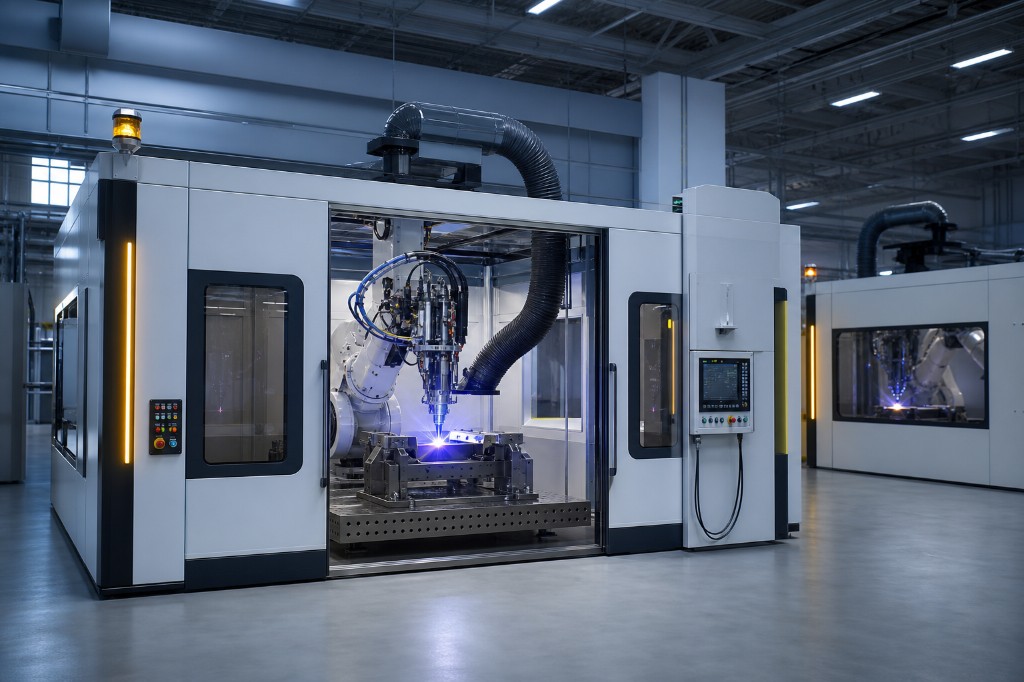
The future of industry: where the digital thread meets the shop floor
Advanced manufacturing in 2026 is where software abstractions meet physical repeatability: robotics and autonomy on the line, sensing and metrology as the nervous system, and a digital thread that is only as trustworthy as the evidence behind it. Corporate capex cycles increasingly favor modular automation that can be retooled, inspection that can be audited, and workforce pipelines that do not assume infinite availability of gray-haired experts. Venture teams, meanwhile, push toward vertical solutions that promise step-change productivity—then discover that the factory floor is a living political economy, not a clean API.
Robotics, autonomy, and the limits of “lights out” storytelling
Industrial robots are mature as machines and immature as systems: integration, safety zoning, teach pendant workflows, and maintenance contracts determine realized uptime. Autonomy—whether in mobile robots, adaptive CNC, or closed-loop quality—adds perception and control loops that must be validated under variance: lighting, vibration, supplier drift, and human coexistence. The credible roadmap speaks in OEE improvements, mean-time-between-failure, and retraining intervals, not in cinematic demos.
Uncertainty is highest where models trained in simulation meet materials that vary batch-to-batch. The gap is closed by metrology: inline sensing, sampling plans, and traceability that tie measurements to decisions. Digital twins can help when they are fed by honest data governance; they become theater when they are fed by aspirational spreadsheets.
The factory does not reward the cleverest algorithm; it rewards the most reproducible loop.
Sensing, metrology, and the economics of trust
Metrology is not a department; it is the currency of manufacturing trust. Coordinated measuring machines, surface inspection, computed tomography for internal defects, and distributed sensor networks on equipment all generate data volumes that collide with IT architectures designed for ERP-era cadence. Edge preprocessing, time synchronization, and tamper-evident logging move from “nice” to “necessary” when customers ask for evidence packs that survive aerospace or medical audits.
Consortium and institute models matter here because capital equipment is expensive and utilization curves favor sharing when programs are staggered. Manufacturing USA’s network of institutes—coordinated federally and documented publicly by NIST—illustrates how public-private collaboration can align pre-competitive R&D with industry-relevant production challenges. The lesson for operators is not to mythologize institutes, but to copy what works: shared equipment with clear IP lanes and projects scoped to measurable manufacturing outcomes.
Digital thread: PLM, MES, and the hard work of identity
The digital thread promise is end-to-end traceability from design intent to field service. The practice is identity resolution: part numbers, revisions, as-built records, and software versions that align when reality diverges from the nominal BOM. Startups often underestimate how much enterprise value sits in boring configuration management. Corporates underestimate how much agility they sacrifice when every change becomes a committee.
A workable middle treats the thread as an engineering product: schemas, access control, audit trails, and APIs that humans can actually use under time pressure. Hub networks help when they publish integration patterns that multiple tenants can adopt—reducing bespoke middleware sprawl across SMEs that cannot afford infinite IT projects.
Workforce: credentials, rotation, and the technician ladder
Workforce constraints show up as queue time on machines and as quality variance. Training programs that pair community colleges, union apprenticeships where relevant, and on-site certification at shared facilities can expand throughput more sustainably than endless requisitions for unicorn hires. The policy conversation often focuses on degrees; the shop floor focuses on demonstrated competence under supervision.
Rotation across nodes—engineers and technicians spending time in partner facilities—also spreads tacit knowledge faster than documentation alone. That is a network effect in the literal sense: it requires deliberate operating norms so mobility does not become IP leakage.
Consortium-style de-risking without killing speed
Shared infrastructure de-risks capital, not judgment. The failure mode is governance bloat: too many committees, too many veto points, and a calendar that moves at the speed of the slowest lawyer. The success mode is staged collaboration: pre-competitive metrology round robins, shared reference datasets with clear usage rules, and pilot lines with published interfaces so startups can integrate without becoming subsidiaries.
Venture investors should diligence consortium participation the same way they diligence a major customer: what gates exist, what exclusivities are implied, and what happens when priorities diverge. Corporate partners should measure success in learning velocity and qualified options—not in logo counts on a slide.
Cybersecurity for operational technology (OT)
Manufacturing floors now blend IT and OT in ways that defeat legacy air-gap assumptions. Remote monitoring, vendor VPNs for service, and patch pipelines for controllers create attack surfaces that require segmentation, identity, and incident playbooks that humans will actually run at 2 a.m. The regulatory and customer pressure is rising; the practical constraint is talent and time. Consortium models help when they publish baseline architectures and run joint exercises—reducing duplicated consulting costs across SMEs.
Uncertainty is high around liability allocation when a subcontractor’s laptop becomes the pivot point. The credible approach is contractual clarity plus technical controls: least privilege, hardware-backed identity where feasible, and backups that are tested rather than merely declared.
Additive, subtractive, and hybrid process chains
Additive manufacturing matured from prototypes toward qualified production in select domains—often where topology optimization justifies post-processing complexity. Hybrid workflows that chain print, mill, and heat treat steps place new demands on fixturing, distortion modeling, and dimensional traceability. The economic question is whether the learning curve is amortized across enough units; the hub question is whether shared post-processing capacity can de-risk early pilots without forcing each team to buy a full secondary operation line.
Corporate partners evaluating additive should insist on measurement system analysis and stability studies, not just tensile bars from a demo day. Startups should treat post-processing as a first-class design variable from day one.
Sustainability, traceability, and customer evidence
Customers increasingly ask for embodied carbon estimates, recycled content claims, and conflict-minerals diligence that can survive audit. Those requests land on suppliers as data problems: lot traceability, material certificates, and energy use per routing step. The digital thread either captures that evidence as it is generated, or teams spend quarters reconstructing history from PDFs nobody trusts.
National and corporate initiatives can align incentives, but the work remains operational: meters on machines, consistent part genealogy, and supplier onboarding that does not collapse under the first rush order.
TRL, MRL, and the missing middle on the factory path
Technology readiness without manufacturing readiness yields pretty prototypes that die at pilot scale. The missing middle is often integration time: fixturing, test harnesses, supplier qualification, and the operational readiness of a supply chain that was never stressed beyond bench quantities. Facilities that expose teams to pilot-line realities earlier—without forcing premature high-volume commitments—compress time-to-credible.
National initiatives that emphasize domestic resilience still have to answer the utilization question: who pays for idle capacity, and how do small manufacturers access advanced tooling without becoming real estate companies? Hub networks propose an answer: aggregate demand, align schedules, and keep safety and quality as non-negotiable shared services.
Quality systems, SPC, and regulated domains
Aerospace, medical, and automotive-adjacent manufacturing impose quality regimes that behave like code: change control, validation evidence, and supplier audits that must remain coherent across years. Statistical process control is not a chart on a wall; it is a decision system that ties measurements to interventions, with roles and accountability that survive shift changes and vacations.
Startups entering regulated markets should budget calendar time for validation infrastructure—not only for the product, but for the processes that manufacture it. Corporate partners can compress timelines when they share templates and sponsor shared pilot lines; they can extend timelines when every deliverable becomes a bespoke legal negotiation.
Uncertainty is highest when a team tries to serve both consumer and regulated customers from the same line without architectural separation. The factory is not a compiler; mixing SKUs without a disciplined plan creates latent defects that show up as expensive recalls or quiet customer churn.
Supplier graphs and regional resilience
Resilience is partly inventory and partly knowledge: who knows how to qualify an alternate source, and how fast can you rerun FAI campaigns without destabilizing production. Regional networks that maintain anonymized supplier capability maps—without violating confidentiality—can shorten searches during shocks. That is collaboration as operational infrastructure, not as conference sponsorship.
Venture diligence should treat supplier concentration as a first-class risk alongside technical risk. Corporate procurement should treat startup survival as part of supply continuity—extreme payment terms and one-sided indemnities can destroy the same ecosystem you claim to depend on for innovation.
Lean systems in a data-rich plant
Lean manufacturing principles did not disappear; they migrated into telemetry-rich environments where the bottleneck is often analytics credibility, not kanban card discipline. Value-stream mapping still matters, but now it must include data latency, model drift in vision systems, and the operational cost of false positives in automated inspection. Plants that succeed unify continuous improvement with MLOps hygiene: labeled datasets, versioned models, and rollback plans that technicians can execute.
Where Ignition Point Labs fits in the industrial stack
Ignition Point Labs frames deep-tech commercialization as infrastructure plus partnerships executed with venture discipline. For industrial teams, that means access models that respect capex reality: shared bays, credible safety culture, and scheduling transparency. It also means treating collaboration as engineered interfaces—so speed survives contact with corporate procurement and federal reporting rhythms.
The pragmatic test is whether a new tenant can run a credible campaign in weeks—not quarters—because safety, scheduling, and metrology norms are already documented and staffed.
The next wins in advanced manufacturing will look less like singular moonshots and more like compounding reliability: fewer surprises per thousand units, faster root-cause closure, and supplier graphs that bend toward redundancy without exploding cost. Networks that teach those skills in public—through shared campaigns, open failure postmortems where IP permits, and aligned training—raise the water table for everyone. That is the pragmatic face of innovation through collaboration.
Measurement systems should also evolve with the process: when a line changes, gauge studies and control limits must be revalidated deliberately rather than silently. The digital thread is only as trustworthy as the change-control discipline behind it—another area where shared training across tenants pays compounding returns.
Operators should also plan for the boring crisis: absent key technicians during flu season, delayed spare parts, and software upgrades that touch controllers. Resilience is partly inventory and partly cross-training—both of which are easier when multiple tenants share a common training spine and a credible surge plan.