
The future of space: commercial mesh, cislunar cadence, and capital that respects physics
By 2026, the space sector is less a single market than a stack of overlapping economies: commercial services in low Earth orbit (LEO), a reconstituting defense-industrial mesh, and a cislunar cadence that is real on procurement calendars even when it is still uneven on cash flows. The through-line for operators and investors is the same as in semiconductors or advanced manufacturing—capital intensity, long verification cycles, and the need for shared infrastructure that converts technical possibility into repeatable delivery.
LEO maturation and the cislunar gradient
Commercial LEO normalized a brutal lesson: launch is necessary but not sufficient. The durable value migrates to services that survive on uptime, data quality, and integration with terrestrial workflows—communications, remote sensing pipelines, and hosted payloads that behave like instruments, not stunts. Cislunar activity adds distance, power, thermal, and navigation constraints that change the shape of diligence. Programs such as NASA’s Commercial Lunar Payload Services (CLPS) illustrate the institutional bet on commercial carriers as a delivery mechanism for science and technology payloads; public program materials describe a multi-provider architecture and recurring task orders, which matters because it implies competition, learning curves, and the need for interface standards that are still being hardened in practice.
What remains uncertain is how quickly revenue-bearing markets beyond government anchor demand will appear at economically meaningful scale. That uncertainty is not pessimism; it is the reason capital structures matter. When timelines stretch, teams need access to testbeds, environmental chambers, and integration bays that do not amortize across a single company’s sporadic usage. That is the economic logic of hubs: convert fixed costs into shared utilization with governance that preserves safety, export control hygiene, and schedule integrity.
Artemis-era priorities—from surface access to logistics concepts—also reframed how terrestrial enterprises think about “space-adjacent” skills: precision mechanisms, fault-tolerant software, and materials that behave under thermal cycling. The boundary between classic aerospace and general industrial deep tech is blurrier than a sector label suggests, which is one reason regional ecosystems that already host robotics, sensing, and power electronics can credibly participate without pretending every company is a launch vehicle shop.
Commercial station concepts and on-orbit servicing narratives, where they advance, will further stress common interfaces: docking, power transfer, data cross-links, and maintenance procedures that assume humans and robots share the same constraints. Progress will be uneven by segment; the durable investment is in verification culture and modular architectures that do not require a program reset every time a partner changes.
The competitive frontier is not who can announce the biggest mission—it is who can ship, learn, and ship again with instrumentation that creditors and customers can trust.
Defense-industrial integration without turning startups into primes
Dual-use is a label; the operating reality is a mesh of primes, subcontractors, software vendors, and new entrants who must speak the same dialect on cybersecurity, supply chain provenance, and configuration management. The U.S. defense ecosystem is explicitly reorganizing around faster fielding and contested logistics; space is inseparable from that story because sensing, communications, and transport are co-evolving. For venture-backed hardware teams, the risk is not “working with DoD”—it is getting trapped in bespoke integrations that consume the company before product-market fit arrives.
Consortium-style collaboration can help if—and only if—it is engineered as productized interfaces: reference architectures, shared test evidence, and clear IP lanes. The goal is not to mimic a prime’s org chart; it is to reduce the transaction cost of credible demonstrations so that a milestone is a verified subsystem, not a relationship map. Where this works, you see repeated patterns: common environmental test campaigns, shared metrology on vibration and EMI, and libraries of lessons learned that travel across teams faster than any single hiring market could supply.
The political economy of defense procurement will continue to oscillate between urgency and oversight. Builders should assume both: urgency creates windows for demonstrations; oversight creates paperwork gravity. A hub operating model that treats compliance artifacts as first-class deliverables—generated alongside hardware, not after it—tends to survive those oscillations better than teams that treat paperwork as a parallel universe.
Supply chain realism: radiation-tolerant parts to clean rooms
Space supply chains inherit the same choke-point dynamics as terrestrial deep tech, with additional screening for radiation tolerance, outgassing, and traceability. Lead times can dominate schedules even when engineering is sound. In 2026, the honest posture for operators is contingency planning: multi-sourcing where feasible, architectural margins where it is not, and early engagement with integration facilities that can catch workmanship issues before they become launch insurance.
Public discourse sometimes compresses “supply chain” into silicon alone. The fuller picture includes mechanical interfaces, thermal materials, test equipment, and skilled technicians who can run campaigns without improvising safety culture. Those layers are where regional hub strategies show up: not as press releases, but as reduced queue times and cross-company learning on the same classes of failures. When two teams debug similar harness issues under different program names but share a facility operator, the network learns faster than either team would alone.
Export controls and deemed-export rules remain a first-order design constraint for multinational teams. The policy landscape shifts; the operational requirement does not: know your classification posture early, design data handling so it is auditable, and avoid “we will fix ITAR later” as a financing strategy. Facilities that routinely host cleared work are not a universal answer for startups, but they are part of the menu when missions require it—and they should be priced and scheduled explicitly.
Instrumentation and verification as the moat
Payload customers—government or commercial—pay for calibrated truth under operational constraints. That shifts advantage toward organizations that can run repeatable test campaigns, maintain chain-of-custody on data, and iterate sensors with disciplined change control. In practical terms, instrumentation access is a capital allocation decision: either you own a finite lab and fight internal scheduling, or you join a network where utilization is metered transparently and safety is non-negotiable.
Technology readiness levels (TRL) remain a useful shorthand for maturity, but hardware teams in integrated missions also live in manufacturing readiness (MRL) territory sooner than they expect. The gap between “it worked on the bench” and “it survived integration” is where programs lose quarters. Shared facilities help when they expose teams early to the messy middle: cable harnesses, grounding, EMI, and the human factors of procedure. The teams that treat those lessons as product requirements—not one-off theater—compound reliability over time.
Ground segment software deserves equal skepticism. A beautiful spacecraft with brittle operations tooling still fails as a system. The same hub logic applies: shared DevSecOps patterns, repeatable simulation environments, and operator training that does not depend on a single heroic individual. Investors should ask about operational readiness with the same intensity they ask about delta-v budgets.
International partnerships—commercial and governmental—remain part of the LEO and exploration stack even when domestic headlines emphasize reshoring. The engineering implication is interface control: ITAR/EAR posture, data residency expectations, and the operational reality of multi-national crews and payloads. Teams that treat export compliance as a living process—not a one-time classification memo—avoid the classic failure mode of discovering a constraint after integration is underway.
Spectrum, debris risk, and the coordination layer
Two slow-moving constraints shape LEO economics: spectrum rights-of-way and debris risk management. Neither yields crisp quarterly metrics, yet both influence insurance, partnership eligibility, and the feasibility of large constellations. Operators increasingly behave like infrastructure utilities—continuity plans, redundancy, and transparent anomaly response—because the alternative is regulatory attention that arrives faster than engineering can adapt.
Standards bodies and multilateral forums matter here less as abstract diplomacy and more as the scaffolding for interoperability: how satellites identify themselves, how conjunction assessments are exchanged, and how new entrants participate without reinventing every interface. For hardware teams, the practical implication is to design systems that emit trustworthy telemetry by default, not as a retrofit after the first close-call headline.
Uncertainty is highest where incentives diverge: operators want agility; regulators want predictability; insurers want actuarially legible behavior. Hub networks cannot resolve those tensions outright, but they can host neutral training, cross-company drills, and shared tooling that make “good citizenship” cheaper than corner-cutting.
Capital intensity and the venture–corporate lens
Space rewards founders who treat capex as a staged hypothesis. Corporate strategics, conversely, evaluate adjacencies to existing franchises—communications, cloud, aerospace structures, energy—often preferring options that plug into procurement rhythms they already understand. The negotiation between those two clocks is where national initiatives and regional hubs can matter: not by picking winners ex ante, but by lowering the cost of credible demonstrations so both sides can meet on evidence.
Investors in 2026 are rightly skeptical of linear extrapolations from press milestones. What still clears the bar is teams that combine mission engineering with operational discipline: clear subsystem ownership, supplier maps that acknowledge single points of failure, and a plan for verification that does not assume perfect facilities on demand. Corporate partners, meanwhile, should avoid treating startups as outsourced R&D unless the governance model preserves independence of technical decision-making; otherwise you recreate prime-sub dynamics without prime-sub economics.
Insurance, launch manifests, and range logistics are not “back office.” They are schedule variables that belong in the same risk register as technical derisking. Long-form diligence that ignores them produces pretty spreadsheets and brittle execution.
Commercial destinations on procurement calendars
NASA’s Commercial LEO Destinations portfolio is intentionally structured around phased Space Act Agreements: early design milestones, shared certification homework, and a bet that commercially owned stations can sequence in before International Space Station retirement pressures arrive in force. Axiom Space is taking an attach-then-detach path—commercial modules on ISS first, then Axiom Station as a free flyer—while continuing to anchor cadence through NASA-managed private astronaut missions. Blue Origin and Sierra Space market Orbital Reef as a mixed-use commercial campus in LEO; NASA has publicly reviewed Reef life-support progress and large-scale burst testing on Sierra Space’s LIFE inflatable structure, a risk-retirement exercise for soft-sided habitation. Voyager’s Starlab joint venture (with Airbus and others on the corporate cap table, and Northrop Grumman contributing cargo logistics and docking-relevant work after pivoting away from an independent station concept) proposes a pre-integrated station delivered in fewer on-orbit outfitting flights—a scheduling claim investors still stress-test against launch vehicle availability. Vast is pursuing Haven-1 as a free-flying pathfinder; company statements and trade reporting now target post-2026 operations after earlier slips—still inside the next-decade window that matters for hub planners deciding when credible commercial destination time becomes a schedule input rather than a narrative overlay.
The competition is less pick-one-winner than expand the collective probability that LEO remains serviced by multiple interfaces for power, docking, and crew time. From a diligence standpoint, treat disclosed launch dates as distributions: integration flow, environmental testing, crew-safety closure with partners like SpaceX, and export-control fit all move the median.
Launch capacity on a widening distribution
NASA remains the buyer that de-risks new human-transport modes when markets cannot carry the learning curve alone—Commercial Crew is the template—and CLPS illustrates the multi-vendor cargo model for cislunar delivery. SpaceX still anchors near-term cadence with Falcon 9 and Dragon while Starship development, if folded into civil workflows at operational tempo, could shift tonnage economics. Blue Origin’s New Glenn is aimed at heavy institutional-class payloads; ULA’s Vulcan carries forward heritage reliability for national-security and high-value science stacks. Rocket Lab is expanding from Electron rideshare toward Neutron; Relativity targets digitally intensive vehicle production; ABL and Stoke represent alternative small-to-medium architectures. Many entrants remain pre-operational as of 2026—models should include manifest halts, not just burn rates.
The systems point for space-adjacent hardware teams: every flight experiment should have a Plan B launcher family and a grounded test traceability plan so a slip does not zero out the learning loop.
In-space manufacturing, InSPA, and adjacent ecosystems
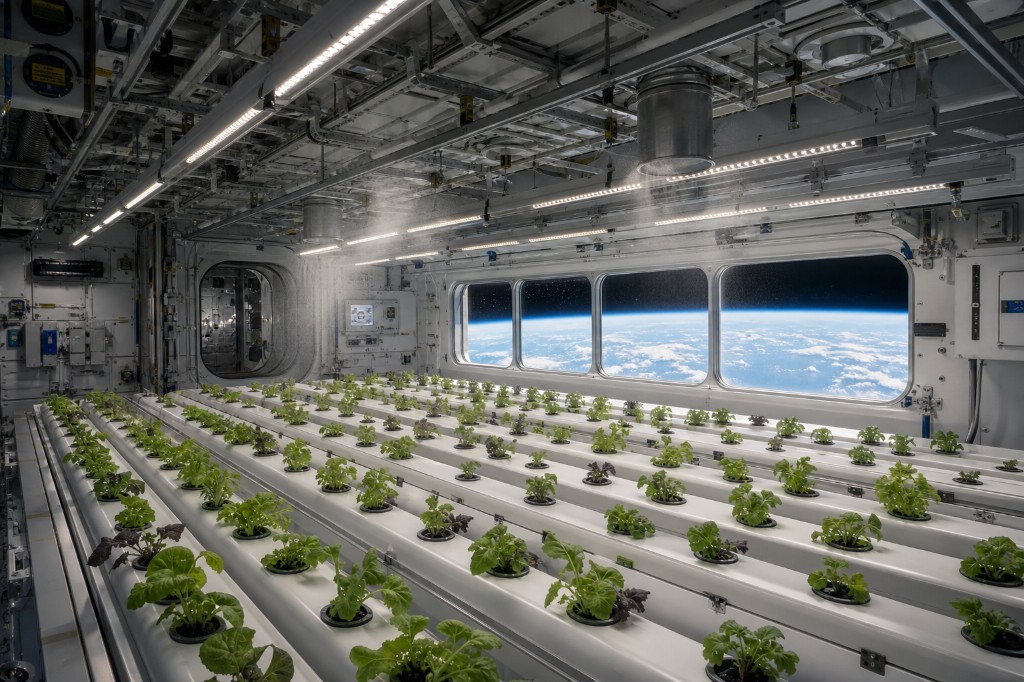
Production in orbit trades convection and buoyancy artifacts for new failure classes—thermal stratification, contamination, limited crew intervention minutes, and downmass economics. NASA’s In Space Production Applications (InSPA) program packages funding, ISS National Lab access, and phased technology maturation for products that can credibly graduate toward terrestrial markets; NASA implementation documents describe TRL gates and increasing cost-share expectations. That policy design matters because it ties public support explicitly to measurable yield—not microgravity theater.
Industrial participants cluster: Redwire and heritage demonstrations (including exotic optical fiber pulls) illustrate high value-to-mass pathways for orbital composites and precision materials; Varda’s return-capsule model targets pharma process development where a few grams of improved crystallinity can justify launch and recovery. Separately, orbital robotics sits upstream of sustained manufacturing—servicing arms, autonomous rendezvous stacks, standardized grapple fixtures—because durable production lines still assume machines can reconfigure hardware without heroic EVA budgets.
Transparency note: NASA’s OSAM-1 servicing demo was discontinued after agency reviews cited integration risk and partner alignment; the episode is a reminder that servicing muscle memory advances even when a single mission does not fly. Primes and startups are both bidding for the next tranche of better-instrumented robotics flights tied to commercial clients with prepared satellites.
Remote presence and space rescue as utilization bottlenecks
Remote presence—teleoperations with meaningful force control, supervised autonomy, and procedure libraries that survive staffing turnover—is what lets a single crew member cover more hardware hours without multiplying launches. Until bandwidth, latency, and certification frameworks make supervised repair routine, utilization of commercial destinations will bump against human-time limits.
Space rescue and responsive servicing are the symmetrical bet: if assets in LEO and GEO remain one-off monuments, insurers, operators, and governments keep discounting the ecosystem’s maturity. Northrop Grumman’s SpaceLogistics Mission Extension Vehicle missions showed commercial life-extension economics in GEO; translating analogous concepts into LEO mega-constellation and debris-aware regimes still requires clearer interference norms and propellant logistics. Improving both remote presence and rescue or servicing pathways directly feeds scalable access—turning orbit from a place you occasionally visit into a working environment you can afford to stay inside when things go wrong.
Why hub networks belong in the space stack
Ignition Point Labs participates in a national conversation about commercializing deep tech without pretending that infrastructure is free. For space-adjacent teams—whether in propulsion, sensing, power electronics, or ground segment software paired with hardware—the relevant question is whether the ecosystem offers a ladder from prototype to pilot production without forcing every company to become a real estate and test-equipment financier. Networks that align equipment pools, training curricula, and supplier introductions across metros reduce the duplicated fixed cost of standing up the same capability in isolation.
The next few years will separate architectures that scale learning from architectures that scale announcements. If you are building in this stack, optimize for cadence: instrumented campaigns, honest postmortems, and interfaces that let collaborators contribute without collapsing governance. That is how collaboration becomes innovation under real constraints—not as a slogan, but as throughput.
Finally, remember that “space” is also a talent market: electromagnetic environmental effects engineers, guidance navigation and control specialists, and integration leads who can run multidisciplinary reviews remain scarce. Hub networks that cross-train and credential practitioners expand the effective labor pool more sustainably than poaching spirals—another form of shared infrastructure with compounding returns.
Sources & further reading
Private stations & commercial LEO programs
- NASA — Commercial LEO economy updates
- Axiom Space — Axiom Station overview
- Blue Origin — LEO destinations / Orbital Reef
- Sierra Space — LIFE habitat program
- Starlab Space — program site
- Vast — Haven-1
- SpaceNews — NASA proposes new strategy for commercial space stations
Launch
- NASA — Commercial Crew Program
- SpaceX — launch vehicles and Dragon
- Blue Origin — New Glenn
- Rocket Lab — Electron and Neutron programs
- United Launch Alliance — Vulcan and launch services
- Relativity Space — Terran launch family
- ABL Space Systems
- Stoke Space
In-space manufacturing & InSPA
- NASA — What is In Space Production Applications (InSPA)?
- NASA — InSPA implementation strategy
- ISS National Laboratory
- Redwire Space
- Varda Space Industries
Orbital robotics & servicing demonstrations
- NASA — Update on status of OSAM-1 project
- Northrop Grumman — satellite services in space (SpaceLogistics)
- GITAI — on-orbit robotics (U.S. entity)